What is a dental implant?
Replacing lost teeth can increase your self-esteem, improve your chewing ability, and help your oral health. With a dental implant, you get a stable and long-lasting solution that looks and feels like a real tooth.
Losing teeth does not mean changing your appearance. Missing teeth can also impair your chewing ability, make it harder to feel how the food tastes and lead to new dental problems and more lost teeth. Dental implants have thus become a common alternative for those who want to replace their lost teeth.
For further details, read our FAQs page.

Why choose dental implants?
Unlike removable dentures or bridges, the great advantages of dental implants are that they are attached to the jawbone. Besides making it easier to chew the dental implant also stimulates the jawbone more like a real tooth. You don't have to worry about them coming loose. This means that with a dental implant you can avoid several of the health problems that occur when you are missing teeth in your tooth row. Another great advantage of dental implants compared to so-called bridges is that dental implants do not need you to grind and drill in healthy nearby teeth.
How to attach a dental implant?
The first step is a thorough examination by your dentist. Among other things, an X-ray to determine if you are a suitable candidate. Having a strong and healthy jawbone is one of the biggest factors that determine whether a dental implant is a suitable solution. Some diseases and medications can also mean that the risk of complications increases and that dental implants may thus be inappropriate. In children, you also need to wait with implants until the jawbone has grown completely to avoid complications.
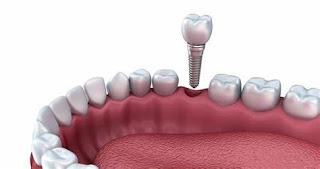
If you have judged to be a suitable candidate, your dentist will then go through the treatment with you and describe the different steps. The first step is to attach the implant itself, the screw, to the jawbone where it will act as an artificial root for your new tooth. This is done through a surgical procedure where the dentist folds away the gums and mucous membrane to reach down to the jawbone. A hole is then drilled in the jawbone into which a titanium screw is attached.
The implant, made of titanium, replaces your natural tooth root, and can provide support for one or more crowns.
The number of implants depends on how many teeth are to be
replaced, but with a completely toothless upper jaw. For example, you may need
as many as six implants to give a stable result.
The fact that titanium screws are used for the implants is because titanium has shown to work well together with the body's tissues and has a unique ability to grow together with the jawbone, which reduces the risk of the implant rejection. The operation is performed under anaesthesia and thus does not hurt during the procedure itself, even if you may experience some tenderness and pain for some time afterwards.
After the procedure, the implants are then allowed to grow
together with the jawbone and the tissue. This process takes different lengths
of time depending on the placement of the implants, but often it takes a few
months up to six months. During this time, you get removable prostheses to fill
the voids with. When the dentist assesses that the implants have grown enough,
you can then attach the new teeth that are usually made of ceramic. If you are
going to replace an individual tooth, the new tooth (crown) is attached
directly to a distance that is attached to the implant. If you need to replace
several teeth in a row, you will instead make a bridge between the implants.
What does a dental implant cost?
Of course, how much a dental implant treatment costs depends
on how many implants you need and how advanced the treatment is. Yet, it is an
extensive procedure and with larger treatments, the cost can be high. Via the
dental care allowance and the high-cost protection, you will receive
compensation of 50 to 85 percent of the reference price. The compensation
depends on the Social Insurance Agency's reference price for the treatment.
Thus, you should choose a specialist.
With a good dentist and good aftercare, dental implants are a stable, effective, and often lifelong replacement for lost teeth. But one should be aware that a dental implant is an extensive procedure that takes several months to complete. The best way to ensure that you get a good and long-lasting result is to go to an experienced specialist dentist. All licensed dentists can insert dental implants, but since it is an advanced procedure, the success rate is much higher for experienced specialists who insert many implants.
Not everyone is suitable for dental implants and an
experienced specialist is so better at assessing whether dental implants are
the best solution for you. It is important to ensure that the dentist uses high
quality implants. Reputable manufacturers guarantee good quality implants,
which increases the chances of success. A good rule of thumb for both dentists
and implant manufacturers is that experience and a good reputation give less
risk of complications, which often becomes cheaper in the long run.
Finishing
After you have your new teeth, your dentist calls you for regular check-ups. This is to ensure that the implants are in good condition and without complications. Also, it is very important to take care of the hygiene around the implant as a real tooth. If the cleaning is not handled correctly, there is a risk that bacteria will descend through the implant and cause inflammation. In the worst case, this can lead to losing the implant. Your dentist will also help you with tips and advice on how to clean the implants in the best way. Smoking increases the risk of problems with your implants. Refraining from smoking is thus essential to guarantee a good result.

Comments
Post a Comment